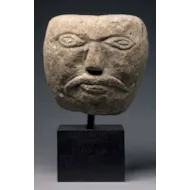
A Carved Celtic Stone Head
A Magnificent Carved Celtic Stone Head Probably Northern British
With a typical down curved moustache and spectacled eyes
1st - 2nd Century AD
Size: 24cm high – 9½ ins high
40cm high – 15¾ ins high (including base)
See: Finch and Co catalogue no. 11, item no. 44, for another Celtic stone head
With a typical down curved moustache and spectacled eyes
1st - 2nd Century AD
Size: 24cm high – 9½ ins high
40cm high – 15¾ ins high (including base)
See: Finch and Co catalogue no. 11, item no. 44, for another Celtic stone head
A Magnificent Carved Celtic Stone Head Probably Northern British
With a typical down curved moustache and spectacled eyes
1st - 2nd Century AD
With a typical down curved moustache and spectacled eyes
1st - 2nd Century AD
Bruce Chatwin has become somewhat of a literary cult figure. Having left Marlborough College in 1958 he worked as a porter in the Works of Art department at Sotheby’s in London where he quickly rose to became their expert on Impressionist Art. After a successful career in the Antiquities and Impressionist picture department he established himself as a travel writer. His passion for travelling intensified during his twenties after a visit to the Sudan where he became fascinated by the nomadic tribes and tried to adopt their way of life. He worked as a journalist for the Sunday Times magazine and wrote a number of books based on his travels including 'In Patagonia' which won the 1977 Hawthornden Prize and the E M Forster award. He continued to write several other highly regarded travel books and novels until his premature death in 1989.
The symbol of the severed human head is as representative of the Celtic religion as is the cross in Christian contexts. From the human skulls found in Celtic hill forts it is known that the head served as a military trophy testifying to the prowess of the Celtic warrior. The powers believed to be inherent in the head were thought to act protectively and keep evil from the fortress and community whilst ensuring continuing positive luck and success.
The symbol of the severed human head is as representative of the Celtic religion as is the cross in Christian contexts. From the human skulls found in Celtic hill forts it is known that the head served as a military trophy testifying to the prowess of the Celtic warrior. The powers believed to be inherent in the head were thought to act protectively and keep evil from the fortress and community whilst ensuring continuing positive luck and success.
Ex Bruce Chatwin (1940 – 1989)
Ex Simon Sainsbury collection, the estate sold at auction 2008
Ex Simon Sainsbury collection, the estate sold at auction 2008
Sold - similar Celtic heads required - please contact with details
A Carved Celtic Stone Head
SOLD
YOU MAY ALSO LIKE